


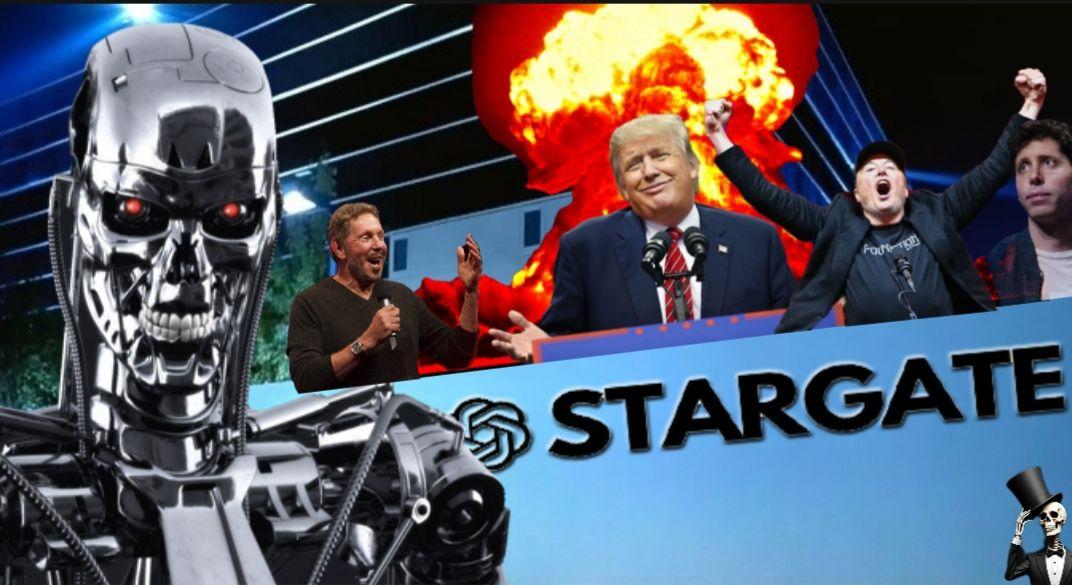
The idea of “Stargate” as a form of AI-driven governance has begun to surface in alternative discussions, often framed as a metaphor for something deeper — a system not fully visible, yet increasingly influential. In this interpretation, advanced technologies are no longer just tools, but part of a broader infrastructure shaping decision-making, control, and long-term direction.Artificial intelligence, once limited to narrow applications, is now expanding into areas tied to governance, security, and data analysis. Systems capable of processing vast amounts of information can influence policy, predict behavior, and optimize responses in ways that were previously impossible. While presented as efficiency and progress, this shift also raises questions about where human oversight ends and automated systems begin.The concept is sometimes linked to what is described as the Fourth Industrial Revolution — a term popularized by Klaus Schwab and the World Economic Forum — referring to the merging of digital, biological, and physical systems. Within this framework, technologies such as AI, biotechnology, and data networks become deeply integrated into everyday life.In more critical interpretations, this integration is seen not just as innovation, but as a restructuring of control mechanisms. Narratives suggest that themes like national security, technological leadership, or even patriotism can act as entry points for broader systemic change — changes that may not be immediately visible at the surface level.References to political figures, including Donald Trump, often appear in these discussions as part of a wider context rather than a single cause. The focus tends to be on acceleration — the idea that certain periods or administrations may intensify trends already in motion rather than initiate them.While these perspectives remain speculative and debated, they reflect a growing awareness of how quickly technological systems are evolving. As AI becomes more embedded in governance and infrastructure, the boundary between support systems and decision-making authority becomes less clear.In that space, questions emerge — not always about what is visible, but about what operates quietly in the background, shaping outcomes long before they are publicly understood.
The idea of “Stargate” as a form of AI-driven governance has begun to surface in alternative discussions, often framed as a metaphor for something deeper — a system not fully visible, yet increasingly influential. In this interpretation, advanced technologies are no longer just tools, but part of a broader infrastructure shaping decision-making, control, and long-term direction.Artificial intelligence, once limited to narrow applications, is now expanding into areas tied to governance, security, and data analysis. Systems capable of processing vast amounts of information can influence policy, predict behavior, and optimize responses in ways that were previously impossible. While presented as efficiency and progress, this shift also raises questions about where human oversight ends and automated systems begin.The concept is sometimes linked to what is described as the Fourth Industrial Revolution — a term popularized by Klaus Schwab and the World Economic Forum — referring to the merging of digital, biological, and physical systems. Within this framework, technologies such as AI, biotechnology, and data networks become deeply integrated into everyday life.In more critical interpretations, this integration is seen not just as innovation, but as a restructuring of control mechanisms. Narratives suggest that themes like national security, technological leadership, or even patriotism can act as entry points for broader systemic change — changes that may not be immediately visible at the surface level.References to political figures, including Donald Trump, often appear in these discussions as part of a wider context rather than a single cause. The focus tends to be on acceleration — the idea that certain periods or administrations may intensify trends already in motion rather than initiate them.While these perspectives remain speculative and debated, they reflect a growing awareness of how quickly technological systems are evolving. As AI becomes more embedded in governance and infrastructure, the boundary between support systems and decision-making authority becomes less clear.In that space, questions emerge — not always about what is visible, but about what operates quietly in the background, shaping outcomes long before they are publicly understood.
0 Udostępnienia
287 Odsłon

 English
 Arabic
 French
 Spanish
 Portuguese
 Deutsch
 Turkish
 Dutch
Dutch
 Italiano
 Russian
 Romaian
 Portuguese (Brazil)
 Greek
Greek