

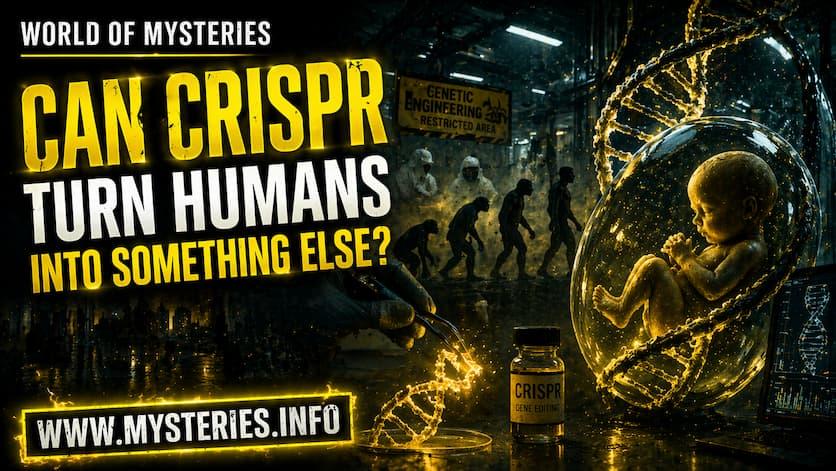
Can CRISPR Turn Humans Into Something Else? What Genetic Engineering Doesn’t Say
It didn’t start with humans. It never does. The first breakthroughs of CRISPR were celebrated as a revolution in medicine. The ability to edit DNA with precision, to remove defective genes, to eliminate diseases before they even begin. It was presented as a tool for healing, for correction, for progress. And for a while, that’s exactly how it was used. At least on the surface.
But every technology that can fix something can also change it.
CRISPR doesn’t just repair DNA. It cuts, removes, and replaces sequences at the most fundamental level of what makes a human… human. Traits are not just corrected. They can be altered. Enhanced. Suppressed. And once you understand that DNA is not a fixed blueprint but a modifiable code, the entire concept of identity begins to shift.
Because if you can edit the code, you can rewrite the outcome.
Early experiments focused on eliminating genetic disorders. That was the public narrative. Remove faulty genes, prevent suffering, improve quality of life. But behind that narrative, another question quietly emerged. If we can remove something undesirable, can we also add something new? Not just fix… but upgrade?
There were already animal studies showing behavioral changes after genetic modification. Increased aggression. Altered fear responses. Changes in social behavior. Not drastic at first. Subtle. Controlled. But consistent. The subjects were still alive, still functioning, but something about them was different. Their reactions didn’t match natural patterns. Their instincts were… adjusted.
Now imagine applying that to humans.
Not openly. Not announced. But gradually, through controlled experiments, clinical trials, and private research. The kind that doesn’t make headlines. The kind that gets buried under technical language and limited access. Because altering human DNA is not just a scientific act. It’s a threshold. And once crossed, it doesn’t come with clear boundaries.
There are already confirmed cases of gene editing in human embryos. Officially, these were isolated incidents, heavily criticized, tightly controlled afterward. But the fact remains: it has been done. Human DNA has been edited before birth. And if it can be done once, it can be done again. More carefully. More quietly.
The real question is not whether CRISPR can change humans.
It’s how far those changes can go.
DNA doesn’t just determine physical traits. It influences brain development, emotional responses, cognitive ability, even how we react to stress and fear. Modify the right sequences, and you don’t just change the body. You change perception. Behavior. The way someone experiences reality.
This is where things start to get… unclear.
Because the line between treatment and transformation is not well defined. Enhancing memory could mean improving cognition. Or it could mean removing the ability to forget. Suppressing fear could help with anxiety. Or it could remove natural self-preservation. Increasing focus could improve performance. Or it could reduce emotional awareness entirely.
Each change seems small in isolation.
But combined… they create something else.
There are theoretical models discussing how multiple genetic edits could interact in unpredictable ways. Not failures. Not mutations in the traditional sense. But new configurations. New expressions of behavior and perception that don’t align with typical human patterns. Not broken. Just different.
And difference, at that level, is difficult to measure.
Imagine a person who feels no fear. Not courage. Not control. Just absence. A person who doesn’t hesitate, doesn’t question risk, doesn’t react to danger the way others do. Or someone whose emotional range is reduced to a narrow spectrum. Calm. Focused. Detached. Always functioning, never overwhelmed, but also never fully present.
These are not science fiction concepts.
They are potential outcomes of altering the systems that regulate human behavior.
And once such changes exist, they can be refined.
CRISPR allows for iteration. Edits can be tested, adjusted, repeated. Over time, patterns emerge. Certain modifications produce predictable results. Others don’t. But the process continues. Quietly. Incrementally. Each step small enough to avoid attention, but together leading somewhere unfamiliar.
There are also concerns about unintended effects. Edits that influence more than their target. Changes that ripple through the system in ways that weren’t expected. Not catastrophic. Not immediately visible. But noticeable over time. Subtle shifts in behavior. Slight deviations in perception. Enough to create a difference, but not enough to raise alarm.
At least not at first.
The idea of “turning humans into something else” is often dismissed because it sounds extreme. Dramatic. Unrealistic. But transformation doesn’t have to be sudden. It doesn’t have to be obvious. It can happen gradually, across generations, through small changes that accumulate over time.
Each generation slightly different.
Each change normalized.
Until the baseline itself shifts.
And when that happens, there is no clear moment where the change began. No single event to point to. Just a slow drift from what was once considered human… to something that still looks human, still functions, but operates under a different set of internal rules.
The most unsettling part is that this process doesn’t require intention in the way people imagine. It doesn’t need a single plan or a defined goal. It only requires progress without clear limits. A system that continues to evolve because it can.
CRISPR opened that door.
It provided the tool to edit life at its source. And once a tool like that exists, it doesn’t stay static. It improves. It spreads. It becomes more accessible, more precise, more powerful. And with each improvement, the range of what’s possible expands.
Including outcomes no one fully predicted.
Officially, CRISPR is controlled. Regulated. Monitored. But regulation follows capability, not the other way around. Science moves first. Oversight reacts later. And between those two points, there is always a gap.
A space where things can happen without being fully understood.
Or fully revealed.
If humans can be edited, even slightly, even safely, then the definition of “human” is no longer fixed. It becomes flexible. Adjustable. Open to interpretation. And once that definition starts to move, it doesn’t easily stop.
Because change, especially at the genetic level, is permanent.
It doesn’t fade. It doesn’t reverse on its own.
It becomes the new baseline.
And if that baseline continues to shift, quietly, gradually, across time…
Then one day, the question won’t be whether humans were changed.
The question will be whether anyone remembers what they were before.
The rest of this data was never meant to be public.
Utilizatori verificați
 Romaian
 English
 Arabic
 French
 Spanish
 Portuguese
 Deutsch
 Turkish
 Dutch
Dutch
 Italiano
 Russian
 Portuguese (Brazil)
 Greek
Greek
 Polski