
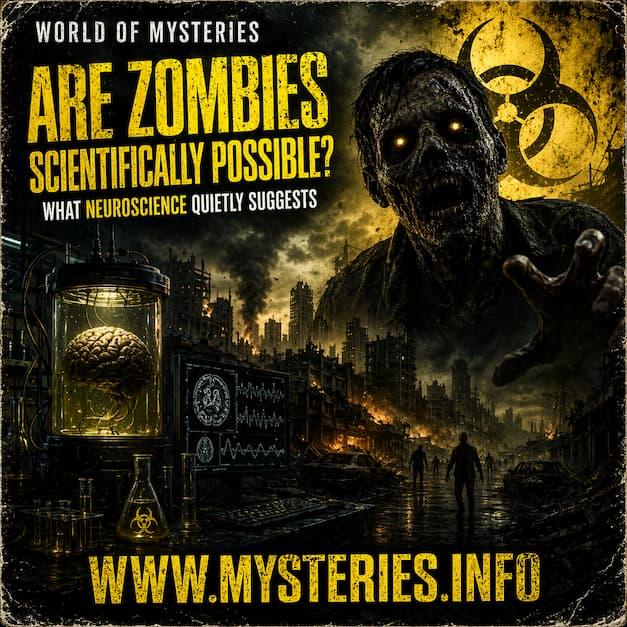
Are Zombies Scientifically Possible? What Neuroscience Quietly Suggests
The first confirmed report didn’t come from a lab, or a military base, or even a hospital. It came from a quiet rural emergency call, logged at 03:17 AM. The operator noted something unusual: the caller wasn’t panicking. He sounded confused. He kept repeating the same sentence over and over, like a loop stuck in his brain. “He’s still moving… but he shouldn’t be.” When responders arrived, they found a man standing in the yard, unresponsive to voice, unresponsive to pain, eyes open but empty. His pulse was slow, his breathing shallow, but his body kept moving. Not randomly. Not violently. Just… moving.
This is where the official story ends.
But if you follow the fragments that never made it into reports, something else begins to emerge. Something that connects scattered incidents, experimental neuroscience, parasitic behavior, and the fragile wiring of the human brain itself. Because the uncomfortable truth is this: the idea of a “zombie” is not as impossible as people want to believe. It’s just misunderstood.
Modern neuroscience has already proven that human behavior, identity, and decision-making are not as stable as we think. The brain is not a fortress. It’s a network. And networks can be disrupted, rewritten, or overridden. There are documented cases where individuals lose entire layers of personality due to trauma or infection. Patients who wake up speaking differently, acting differently, even reacting to fear in completely altered ways. The line between “self” and “system failure” is thinner than it should be.
One of the key areas involved is the prefrontal cortex, responsible for decision-making, impulse control, and awareness. Damage or suppression of this region doesn’t kill a person. It removes the brakes. What remains is raw behavior, stripped of context. Movement without meaning. Reaction without reflection. In controlled experiments, stimulation of certain brain regions has triggered involuntary actions. Limbs move without permission. Choices are made before the person is even aware of them. Now imagine this process not as a momentary glitch, but as a permanent state.
There are also deeper systems involved. The limbic system, responsible for emotion and survival instincts, can become dominant when higher functions shut down. Fear, hunger, aggression. These are not learned behaviors. They are embedded. Primitive. If something were to suppress higher cognition while leaving these systems active, you wouldn’t get a “dead person walking.” You would get something else entirely. Something alive, but not present.
And then there are parasites.
In nature, there are organisms that don’t just infect a host. They control it. Certain parasites can alter the behavior of animals in precise ways. They change fear responses. They influence movement. They guide the host toward environments that benefit the parasite’s lifecycle. It’s not theory. It’s observed. Measured. Repeated. The host remains biologically alive, but its decisions are no longer its own.
Now scale that concept.
There have been studies on infections that affect the human brain, subtly altering behavior. Increased risk-taking. Reduced fear. Changes in reaction time. Most of these are dismissed as minor effects. Background noise. But what happens when the effect is not minor? What happens when the influence is not subtle?
There are whispers of experiments that tried to answer that question.
Fragments of research into neural modulation, originally intended for medical use. Restoring movement in paralyzed patients. Treating severe depression. Enhancing cognitive performance. But every system that can repair can also be misused. Signals can be amplified. Suppressed. Redirected. If you can stimulate movement, you can trigger it. If you can suppress emotion, you can remove empathy. If you can interfere with perception, you can disconnect someone from reality while their body continues to function.
There are reports, unverified but consistent, describing subjects who entered a state where they could move, respond to basic stimuli, but showed no signs of awareness. No recognition. No hesitation. No fear. Pain did not register in the usual way. Commands were followed, but not understood. The brain was active, but not conscious in the way we define it.
This is where the definition of a “zombie” starts to shift.
It’s not about the dead returning to life. It’s about the living losing what makes them human while their bodies continue to operate. A system running without its core identity. A biological shell driven by fragmented signals. And unlike fiction, this wouldn’t look dramatic. It wouldn’t be loud or chaotic at first. It would be quiet. Subtle. Easy to ignore.
People would just… change.
They would become slower to respond. Less expressive. Detached. Then more reactive. Less predictable. Movement would feel off, slightly delayed or slightly too precise. Eye contact would disappear. Language would degrade. Not all at once. Gradually. Enough that it could be explained away. Stress. Illness. Fatigue.
Until it couldn’t.
The most disturbing part is not that this could happen. It’s that the mechanisms already exist. Brain regions can be suppressed. Behavior can be altered. External signals can influence neural activity. Biological agents can modify host behavior. None of these are science fiction. They are separate pieces of a system that, under the right conditions, could produce something very close to what we describe as a zombie state.
And if such a state were possible, it wouldn’t be announced. It wouldn’t be explained. It would be contained. Or hidden. Or studied quietly while the public is told something simpler. Something easier to accept.
There are already small anomalies. Incidents that don’t fit clean categories. Reports of individuals behaving in ways that defy typical neurological explanations. Cases that are quickly labeled, filed, and forgotten. But patterns don’t disappear. They just become harder to see when no one is looking for them.
The real question is not whether zombies are possible.
The real question is how close we already are.
Because if the brain can be overridden, if behavior can be redirected, if identity can be stripped away while the body continues to function, then the concept is no longer fiction. It’s a threshold. And thresholds, once crossed, are rarely noticed in the moment they happen.
By the time people realize something is wrong, it’s already part of the system.
And systems don’t stop themselves.
Usuários Verificados
 Portuguese
 English
 Arabic
 French
 Spanish
 Deutsch
 Turkish
 Dutch
Dutch
 Italiano
 Russian
 Romaian
 Portuguese (Brazil)
 Greek
Greek
 Polski