


The Russian Sleep Experiment: What Woke Up Should Have Stayed Hidden
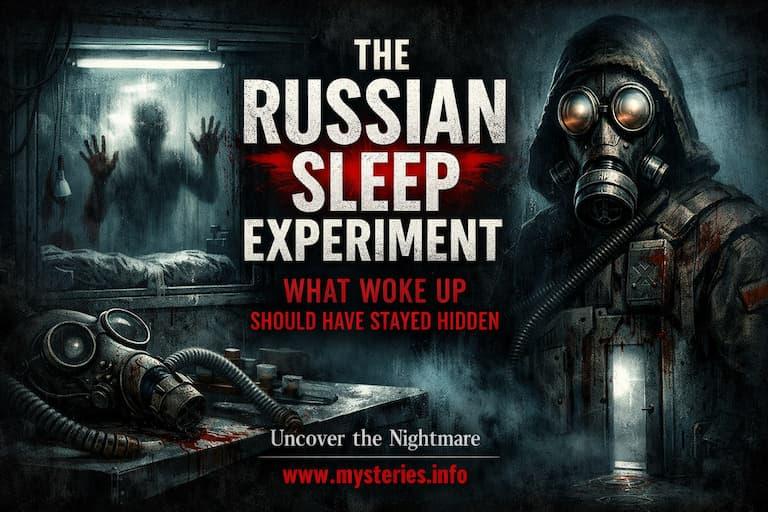
The Russian Sleep Experiment is one of those stories that feels less like an experiment and more like something that should have never been attempted in the first place. In the late 1940s, Soviet researchers allegedly kept five political prisoners awake for fifteen days using an experimental stimulant gas. The subjects were placed in a sealed chamber where their oxygen consumption could be monitored, and where the gas could be controlled so it wouldn’t reach lethal levels. This was before modern surveillance, so instead of cameras, the room was equipped with microphones and a small, thick glass window for observation. Inside were books, cots without bedding, enough food for over a month, running water, and a toilet.
The test subjects were political prisoners arrested during World War II.
For the first five days, everything seemed normal. The subjects didn’t complain much, largely because they had been promised, falsely, that they would be released if they completed thirty days without sleep. Their conversations were monitored, and over time, the topics began drifting toward traumatic experiences. By the fourth day, the tone had noticeably darkened.
After five days, they began to show signs of severe paranoia. They stopped talking to each other and instead whispered into the microphones and toward the observation glass. It seemed as though they believed they could gain the researchers’ trust by turning against one another. At first, the scientists assumed this was simply an effect of the gas.
On the ninth day, one of them started screaming. He ran from wall to wall, screaming at the top of his lungs for three hours straight. After that, he continued trying, but could only produce occasional squeaks, likely having damaged his vocal cords. What was truly disturbing, however, was how the others reacted—or rather, didn’t react. They continued whispering to the microphones until another subject began screaming as well. Then, the remaining two began tearing apart books, smearing the pages with waste, and covering the observation window. After that, the screaming stopped.
So did the whispering.
For the next three days, there was complete silence. The researchers checked the microphones hourly, assuming they had malfunctioned, because it seemed impossible that five people could remain completely silent for so long. Oxygen consumption, however, indicated they were all still alive—and even suggested unusually high levels of physical activity.
On the morning of the fourteenth day, the researchers broke protocol. They used the intercom, hoping to provoke any kind of response. They announced: “We are going to open the chamber to test the microphones. Step away from the door and lie flat on the floor, or you will be shot. Compliance will result in one of you being released immediately.”
To their surprise, a calm voice replied: “We no longer want to be freed.”
Confusion spread among the researchers and the military overseeing the experiment. With no further responses, they decided to open the chamber at midnight on the fifteenth day.
The gas was turned off and replaced with fresh air. Immediately, voices came through the microphones—three of them, begging desperately for the gas to be turned back on, as if their lives depended on it. When the chamber was opened and soldiers were sent inside, the subjects screamed louder than ever before.
The soldiers screamed too.
Four of the five subjects were still alive, though calling them “alive” barely seemed accurate. The food rations beyond the fifth day had gone untouched. The drain in the center of the room had been blocked, allowing liquid to pool across the floor. It was unclear how much of it was blood.
The surviving subjects had suffered severe physical damage, much of it self-inflicted. Their bodies were in horrifying condition, yet they remained conscious. Despite everything, their digestive systems were still functioning.
Many of the soldiers refused to return to the chamber after what they had seen. The subjects, meanwhile, resisted removal, pleading to remain inside and demanding the gas again so they wouldn’t fall asleep.
When they were finally removed, chaos erupted. One soldier died, others were severely injured, and several later took their own lives. One subject died from injuries sustained during the struggle. Attempts to sedate the others failed—no matter how much was administered, they remained conscious and violently resistant.
Even during surgery, they refused anesthesia. One subject, unable to speak, communicated by writing a simple message: “Do not stop cutting.”
The remaining subjects continued to demand the gas. When asked why they had done this to themselves, why they feared sleep so much, they gave only one answer:
“I must not sleep.”
Eventually, the surviving subjects were restrained and returned to the chamber, despite objections from some of the researchers. The military wanted to continue the experiment.
As preparations were made, one subject began humming continuously. Another strained against his restraints, as if focusing on staying awake. The third blinked rapidly, his brain activity monitored. At times, his readings flatlined briefly, as if he was slipping into death and returning again.
Then, at one moment, his eyes closed.
His heart stopped instantly.
The last remaining subject began screaming for the gas. His brain activity showed the same pattern. A commanding officer ordered that the chamber be sealed again—with the subject and several researchers inside.
At that moment, one of the scientists drew a gun, shot the officer, and killed another subject. He then aimed at the last one, still restrained, as the rest fled.
“I won’t be locked in here with this thing,” he shouted. “What are you?”
The subject smiled.
“Have you forgotten so easily?” it said. “We are you. We are the madness that lives inside all of you, waiting to be free. The thing you hide from every night when you go to sleep.”
The scientist hesitated for a moment.
Then he fired.
As the subject lay dying, its final words were barely audible:
“Almost… free.”
Πιστοποιημένοι χρήστες
 Greek
Greek
 English
 Arabic
 French
 Spanish
 Portuguese
 Deutsch
 Turkish
 Dutch
Dutch
 Italiano
 Russian
 Romaian
 Portuguese (Brazil)
 Polski