
Are We Being Watched Without Knowing It?
Cameras, data, patterns. Are we being watched without knowing it, or is the system already far ahead of what we understand?

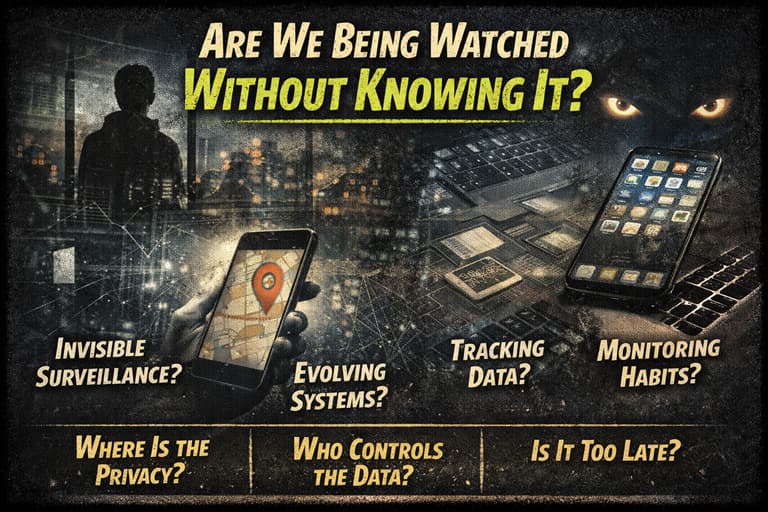
Are We Being Watched Without Knowing It?
There is a quiet shift happening in the background of everyday life. No alarms. No clear moment where everything changed. Just a slow, almost invisible transformation of how information flows, how behavior is tracked, and how presence is recorded.
The question is no longer whether surveillance exists.
The question is how much of it we actually see.
The Illusion of Privacy
People still believe in private space. A room with closed doors. A conversation not recorded. A moment that belongs only to them. But the structure of modern systems suggests something else entirely.
Devices listen. Platforms track. Patterns are collected and analyzed in ways that are never fully explained. Surveillance today does not always look like cameras on walls. It looks like data, movement, habits.
And most of it happens without resistance.
How Surveillance Blends Into Normal Life
What makes modern surveillance different is not its power, but its subtlety. It does not feel forced. It feels convenient. Phones respond instantly. Apps predict behavior. Systems adjust before a decision is even made.
This creates a strange effect.
You are not being watched in an obvious way. You are being understood.
And that may be far more powerful.
The Rise of Invisible Monitoring
When people think of surveillance, they imagine something visible. Cameras, agents, controlled spaces. But the real shift happened when monitoring became invisible.
Search history. Location data. Interaction patterns. These are forms of surveillance that do not feel like observation, yet they reveal far more than a camera ever could.
The system does not need to see you directly.
It needs to predict you.
Are We Voluntarily Participating?
There is a deeper layer to this question. What if surveillance is not imposed, but accepted? Every device used, every platform joined, every interaction recorded—it all builds a system that grows stronger with participation.
Not forced.
Chosen.
This creates a paradox. The more connected the world becomes, the less visible the boundaries of privacy are.
The Question of Control
Who controls this information? That question appears often, but the answer is rarely clear. Data moves through systems that are too complex to trace easily. Ownership becomes blurred. Responsibility becomes distant.
And in that uncertainty, control becomes difficult to define.
Which may be the point.
Patterns That Go Unnoticed
There are moments when systems respond too quickly. Recommendations appear before a search is completed. Content aligns too precisely with thoughts not yet expressed. These moments are often dismissed as coincidence.
But patterns rarely form without structure.
And structure implies design.
Looking Beyond the Surface
To ask whether we are being watched is to ask a deeper question about the nature of modern systems. Surveillance no longer needs to feel intrusive. It can exist quietly, efficiently, almost invisibly.
The absence of awareness does not mean the absence of observation.
It may simply mean the system has evolved beyond recognition.
The Space Between Awareness and Reality
There is always a gap between what people believe is happening and what is actually happening. In that space, assumptions grow. Trust is placed in systems that are not fully understood.
And yet, something feels slightly off.
Not enough to trigger alarm.
But enough to raise a question.
What If We Are Already Inside the System?
Perhaps the idea of being watched suggests distance, as if observation comes from outside. But what if there is no outside? What if the system is not watching from afar, but operating from within the very structure of daily life?
Then the question changes.
It is no longer about being watched.
It is about being part of something that is always observing.
This may interest you
https://mystery-network.com/blog/aaro-shutdown-congress-luna-uap-disclosure